From Test Bench to Orbit: Why COSMOS + Keysight is the Ultimate Power Duo for Satellites
In aerospace, time-to-orbit is everything. Yet many teams keep hitting the same wall: proving the combined hardware and software performance of a launch-ready satellite. OpenC3 partner Keysight Technologies put it perfectly: The pace of a program depends less on the design than on how fast that design can be connected to real hardware and exercised. The problem is one of rapid test harnessing: how quickly a team can stand up a working command, control, and validation setup around its hardware, and how much of that setup survives the jump from the bench to orbit.
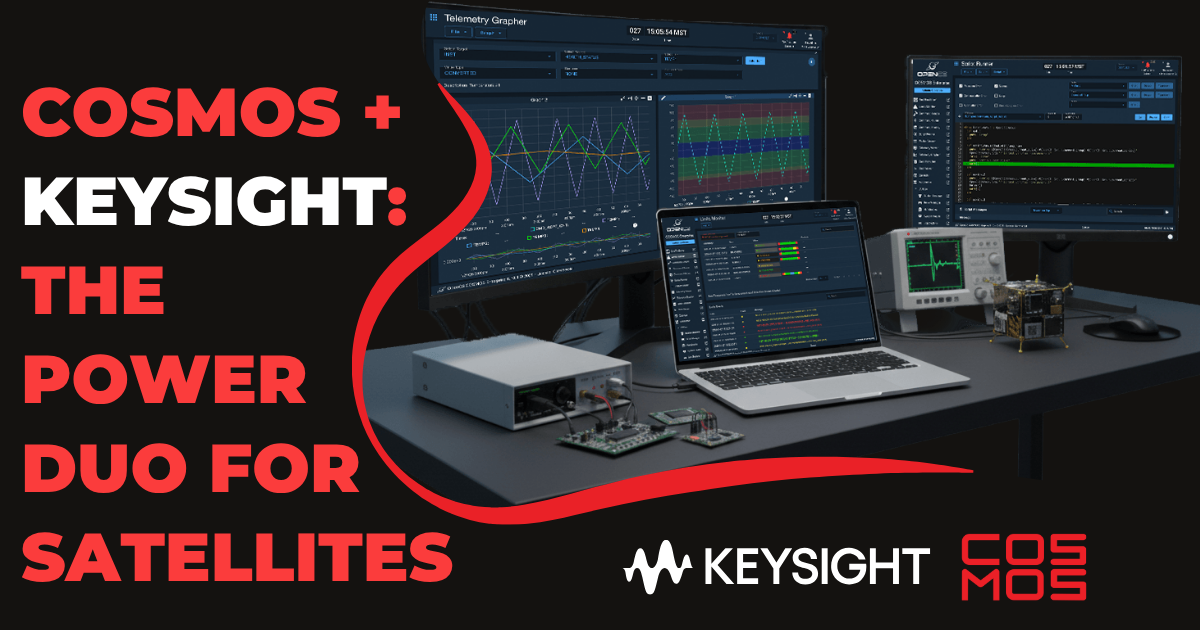
We know COSMOS works across the lifecycle and with a variety of hardware, but we’re lucky to have a great partner who helps us prove it. Through our partnership with Keysight Technologies, we have access to their innovative hardware. They send us the equipment to create the plugins so teams don't lose time building custom integrations over and over again. Keysight hardware is ready to connect to COSMOS right out of the box.
The exact same software used to command Keysight hardware on the test bench is used to command the actual satellite in orbit. OpenC3’s and Keysight’s partnership throws open the doors for hardware orchestration in the future, but we want to take a moment to step back in time and see how this partnership started.
OpenC3’s Partnership with Keysight: How it Started
COSMOS users have relied on Keysight instruments for years, but the partnership became more formal during a conversation at the Tectonic Defense Summit. Keysight and OpenC3 were circling the same question from opposite sides: how do we give customers greater success with their test equipment so they can stay focused on their mission?
Orchestrating hardware and software together is often the difference between a year in test and a month, or between a program that dedicates an engineer to writing test instrument integrations and one that puts that headcount on the payload instead.
Separately, the work landed on the customer. COSMOS users wrote their own plugins for every piece of equipment on the bench — power supply, digital multimeter, oscilloscope, power switch, whatever the rack held. Every team rebuilt the same integrations, and none of that work was shared. Together, we publish those plugins for Keysight products so integration takes minutes instead of weeks, and nobody writes the same driver twice.
A Plug-and-Play Partnership: The Software-for-Hardware Development Process
Our engineers were excited to tackle these integrations for different pieces of Keysight hardware. And once we taught COSMOS the language that the hardware speaks, Standard Commands for Programmable Instruments (SCPI), the integration process was rather straightforward.
To build a COSMOS plugin for Keysight hardware, the steps look like:
- Start from the COSMOS plugin template and point it at the instrument's connection — Ethernet, USB, or GPIB.
- Define the SCPI command and telemetry set from the instrument's programming guide. COSMOS command and telemetry definitions map almost line-for-line onto SCPI mnemonics.
- Connect and verify. COSMOS gives you UI tools like Command Sender and Packet Viewer to immediately test your commands and verify your telemetry.
- Build screens and scripts on top. Now the instrument is scriptable alongside every other piece of hardware in the rack.
The instrument keeps doing what it does best. COSMOS supplies the UI, logging, and automation layer around it, which means one piece of software for the whole bench instead of a dozen vendor-specific applications.
The entire test rack becomes controllable from COSMOS in a few clicks. Work that traditionally meant months of custom development is now an install from store.openc3.com. That's months of ground software development that developers get back and can spend on the payload or spacecraft instead.
Stop Writing Drivers, Start Collecting Data
Before this partnership, we knew how teams looked at instruments. Every single one was its own island. Engineers needed separate vendor applications, separate UIs, and separate ways to script. Teams were wasting weeks writing custom drivers and building throwaway software just to get to the test phase.
Even worse was knowing that none of the code was reusable. The plugin one engineer wrote left with them, and the next program started over. Not to sound like a ‘90s infomercial, but there had to be an easier way.
And the OpenC3 Store is that way. Now, the integration is already done, already tested, and the whole rack logs and scripts through one system. Buying an instrument should not mean adopting another piece of proprietary software and another silo of data. OpenC3 has been leading the shift toward vendor-agnostic software that unifies hardware rather than fragmenting it.
OpenC3 and Keysight's shared customers are starting to expect that hardware arrives ready to integrate into the control system they already run, and that the software layer is open enough to hold every vendor on the bench at once. This partnership is a concrete example of what that looks like. OpenC3 and Keysight Technologies continue building and fulfilling that expectation, one test at a time—even when it looks like having fun by building your own weather station in your backyard like Staff Software Engineer Clay Ito did!
Visit the OpenC3 Store to see all the different plugins that can be installed in minutes with OpenC3 COSMOS.
Want to know more about Keysight Technologies? Visit their website!