Space Software Summit 2026 Debrief: What Aerospace Engineers Need to Know
Space Software Summit 2026 has concluded! While we try to catch up on emails (and sleep) after three days of workshops, engaging talks, educational sessions, and networking, we also want to take a second to recap the highlights of the Summit.
Thanks are also in order to our sponsors and exhibitors for helping make this conference possible and such a success. This year’s sponsors included OpenC3 and Odyssey Space Research. Right Ascension 231 sponsored the event by hosting a workshop, Build an Agent-Ready Data Lakehouse, and Zendir also hosted a workshop, Orbital Intel: Mission Operations Under Pressure. Thank you for your support and commitment to providing continued education for aerospace software engineers.
This year we had six different talk tracks for our attending space software engineers: AI, Flight Software, Simulation, Architecture, Algorithms, and Hot Topics. If you attended and want a refresher from the sessions or you weren’t able to attend the software conference, we’ve rounded up our favorite takeaways from each session.
Key takeaways from Space Software Summit
AI
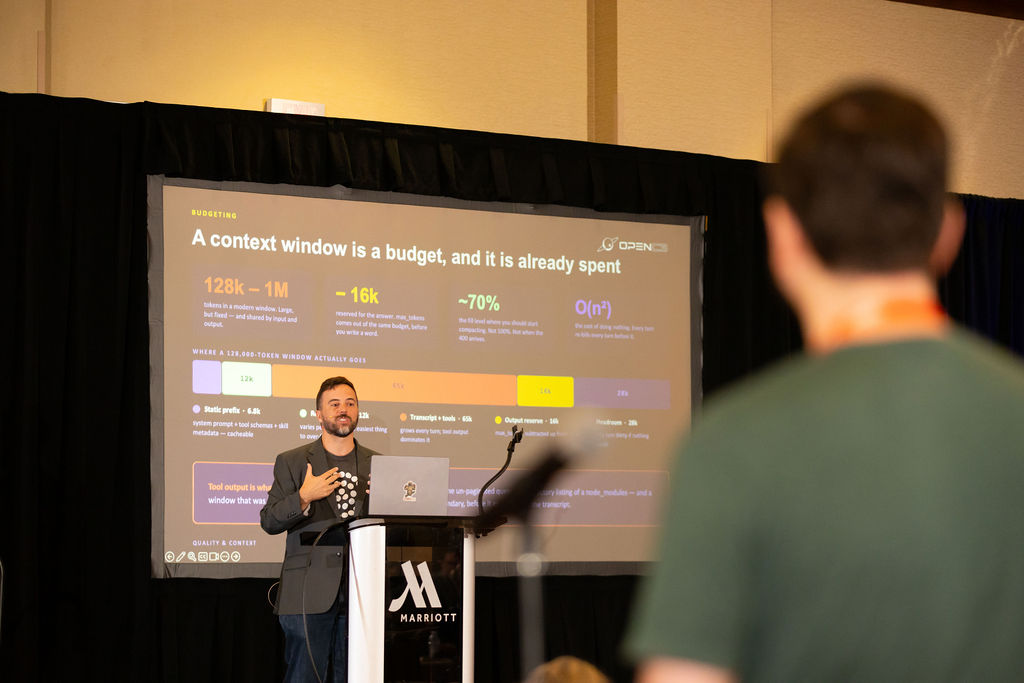
OpenC3’s CEO Ryan Melton opened the conference with his keynote that addressed: How to use AI in software development without adding risk. Jacob Seman from CU LASP then took the stage to talk about Autonomous Skill Synthesis and Tools for Aerospace Coding Agents. Sean Nelson from Kayhan Space then spoke about Guiding Operators from CDMs to Clarity. Finally, Clay Ito from OpenC3 talked about creating a RAG during his presentation Ask, Don’t Search—Chat is the new Docs.
Takeaways from the AI for aerospace software developers sessions:
- The harness is the product. Loop control, sandboxing, budgets, and traces are where reliability in AI actually lives. The model is one component.
- With AI, developers are moving away from writing code and the effort has been shifted to architecture, requirements, design, and review.
- Domain skills and purpose-built entry points resonate with and reinforce the underlying structure. A strict framework and a strongly typed language give agents firm ground to build on, with little room to go wrong.
- Your top priority is to secure access to data. Enforce authentication and protect sensitive data when integrating AI in your workflows.
- Using a RAG (Retrieval Augmented Generation) requires a mental model shift from channel navigation (documentation, social media, blogs, release notes, etc.) to question navigation (Can you point to the docs that have examples of X? How can I use this Product for my Mission?)
We heard attendees loud and clear that AI is on everyone’s mind and engineers are looking for their peers to share how AI is working in the real world. What are the wins? What have been some of the lessons learned after coding with AI for a few months or years? Developers are now looking for the data, not just the theories of what’s possible with AI.
Flight Software, sponsored by Advanced Space
First up for the Flight Software track was Jim Craft from BAE Systems talking about The Agentic Spacecraft: An Architecture for Inference-First Autonomous Space Operations, then Erik Long from Orbotic Systems came on stage for his presentation, Predict Before Failure: Onboard Environmental Intelligence for Resilient Space Systems. Jules Smith from Orbit Fab talked about Orbit Fab: Reusable, Reliable, Refueling before giving the microphone to Lorn Miller from Red Canyon Engineering & Software to present The Comparison of Flight Software Architecture, specifically cFS and F Prime (F’).
Key takeaways from the Flight Software sessions:
- Being operationally efficient means that Ground sets objectives and boundaries. Spacecraft manage time-critical choices.
- There’s a challenge in moving from data collection to timely onboard understanding and interpretation, which is why better prediction tools are needed. Prediction creates time. Time creates response options.
- The phrase “seems easy enough” always becomes a bigger problem in software development.
- Frameworks exist for a reason and documentation is a must. Though, in practice it’s been found that nothing is as permanent as a temporary fix.
- Test early and test often, don’t be afraid to test as you fly. Custom testing hardware leads to testing hardware debugging.
- Which is better between cFS and F Prime? It depends! Both are industry standard and both use C and C++ programming languages. The differences lie in whether they default to monolith or multiple shared objects, whether it’s manual or automatic documentation, and how nicely they play with other systems. It depends on the team and mission when it comes time to choose.
Simulation
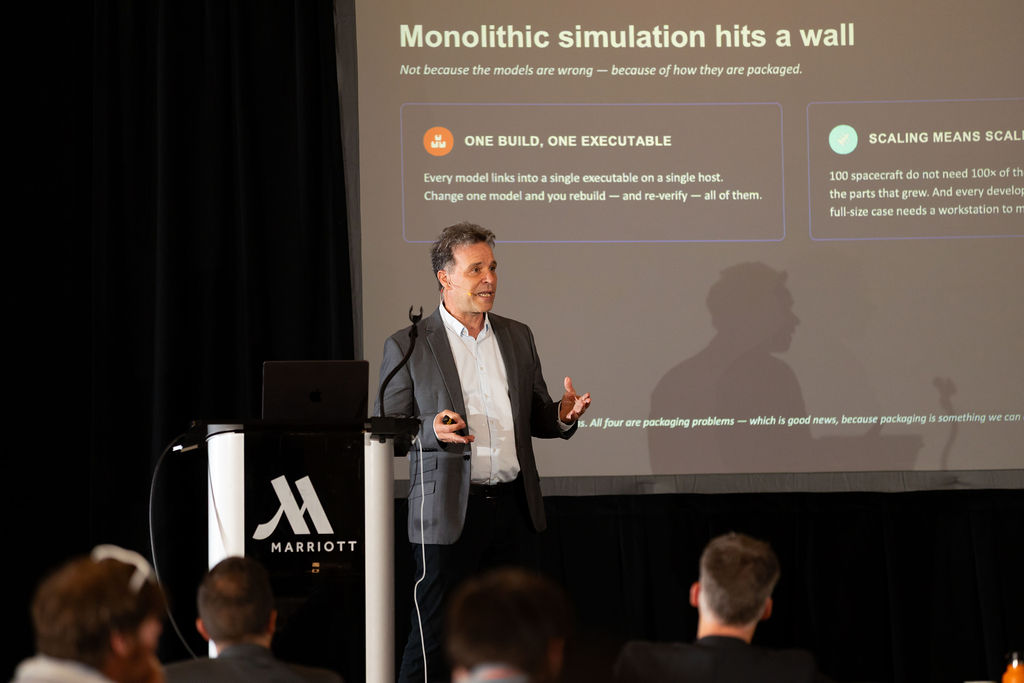
First up in the simulation talk track was Asaf Lewin from Sim Dot Space to talk about The Microservices Shift: Future-Proofing Next-Gen Satellite Constellation Simulations, then Chris Oravetz from Verge Defense joined us to walk through Bridging Operations and Simulation with SysML Orchestration.
Key takeaways from the Simulation sessions at Space Software Summit:
- Rule of thumb: If a message crosses a process boundary more than a thousand times a second, it’s an architecture decision—not a configuration setting.
- A run you cannot replay is an anecdote. A run you can replay is a test.
- When scaling to a constellation, keep in mind that the cluster you need in year three is not the one you can buy in year one. If your simulation is small, fits on one box, builds in one shot, and nobody outside your team needs it, stay monolithic. This architecture earns its keep at scale, across projects, across model and simulation versions, and over time—not on day one.
- The SysML v2 Model builds on the thesis of having one model design, test, and build ops products. The structure and behavior already live in the model. Model execution parses it, orchestrates it, and renders it for lifecycle uses.
- SysML v2 improves satellite design by formally defining spacecraft, ground, payload, and subsystem interactions. It connects mission needs through design, analysis, and verification. It includes integrated behavior modeling and interoperability between tools. Finally, it produces one source of truth to reduce ambiguity and enable automation.
Architecture
First up was James Santucci from Umbra to tell the room about Lies Ground Software Taught Me, then Jacob Kovarovic from Southwest Research Institute talked about Modernizing Legacy Laboratory Control Software for Satellite Instrument Calibration. One of our technology partners, Keysight Technologies, was represented by Sijia Qiu who shared how The Sky is Falling (with Data)! Finally, Nick Gent from Space Exploration Engineering talked about The Hard Parts of Distributed Flight Dynamics Software.
Key takeaways from Space Software Summit’s Architecture sessions:
- If something goes wrong, gathering info is cheap. If something goes slightly more wrong, deploying a new version to get better info is cheap. If something goes really wrong, rolling back is cheap.
- Modernizing software is a people problem before it’s a technology problem.
- When thinking about the future for development, you must fix the conditions that led to unsupportable software. It’s about improving the development process, not just the tech stacks.
- Hardware is a firehose in a sinking boat. Software is trying to bail out that boat with a cup. Today’s hardware and instruments could be logging terabytes of data every hour and taking up precious disk space and time from engineers.
- A failure near the end can erase hours of progress. Write progress to disk after every step.
Breakout Session Highlights
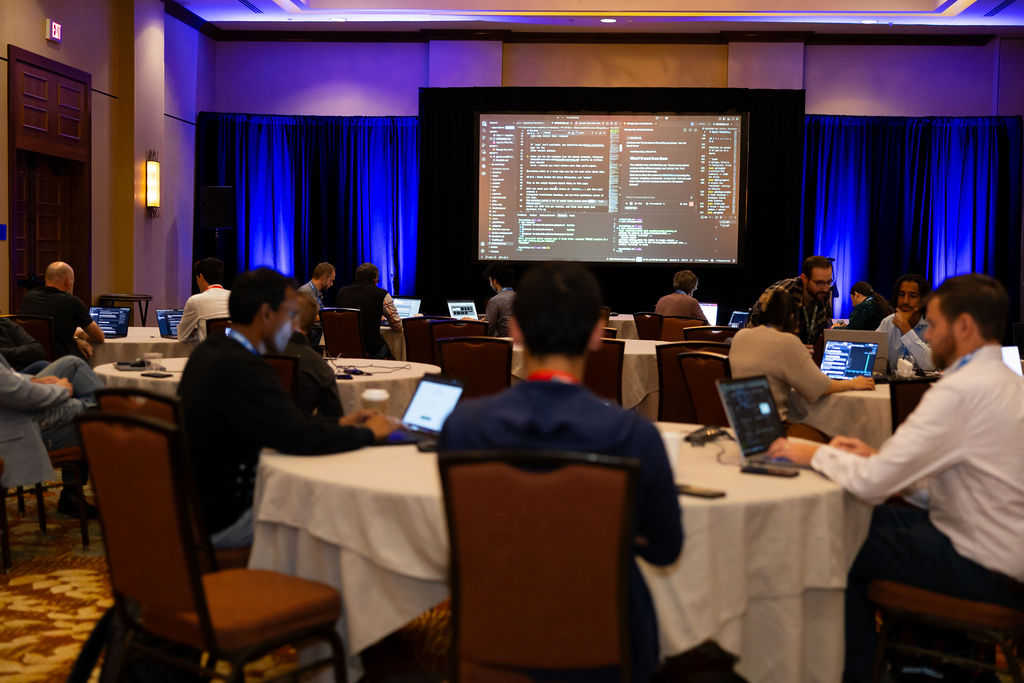
We had three options for breakout sessions on Wednesday: COSMOS Mini-Con, the AI Vibe Coding Hackathon, and Problem Solvers.
At COSMOS Mini-Con, attendees learned more about our development process and what went into each release, as well as some insight into what the future of COSMOS has in store for software developers.
At the AI Vibe Coding Hackathon, engineers were prompting and building software that would display data in a unique and fun way. Seven engineers submitted their projects to be eligible for the award, and scroll down to see who won the hackathon! Funnily enough, they’re from a hardware company!
And over in Problem Solvers, engineers were putting their heads together to solve problems. Developers could anonymously submit problems they were trying to solve and collectively the group discussed the most popular problems.
Problems that were addressed during the session:
- Should you have foundational knowledge of a programming language before having AI write in it?
- How vulnerable is edge computing in space?
- How do we train new developers or create senior developers if AI replaces their roles?
- Is it bad that we have a huge decrease in boredom?
There were some lively discussions on these questions. For the foundational knowledge one, it was an interesting split where the majority said no. It was shared that we’ve been guilty of gatekeeping in the past and should open up our industry and welcome new players, even assisted by AI. It was emphasized that, at the end of the day, AI is a tool and when anyone needs a tool, they’ll learn how to use it. We’ll still need human engineers to step in and review code as AI tends to do too much and be inefficient. Engineers will still have a stake in being responsible for that code.
There was a spectrum of opinions when it came to the vulnerability of edge computing in space. About 60% of attendees agreed it wasn’t vulnerable and redundancy is our safety, 30% shared the opinion that it was very vulnerable and we shouldn’t do it, and 10% agreed it was also very vulnerable but differed and said we have to do it.
When talking about training and enabling developers to move into a senior role, attendees stressed the importance of company buy-in to hiring junior developers and training them, investing in bootcamps and having pipeline companies to train developers for future roles, and understanding that the senior engineer job will change and we need to change with it.
Finally, there were lots of opinions on how to define boredom today and how much boredom is good for us. The majority of people seemed to say that yes, decreasing boredom is bad, 30% shared the view that boredom is good but they don’t necessarily like being bored, and 10% said no, it’s not bad and they prefer to not be bored!
Algorithms
First up was David Groeneveld from Resolv to discuss A New Paradigm to Atmospherically Correct VNIR Imagery to Surface Reflectance. Next up was Collin Sinclair from KSAT to talk about When the Spec Doesn’t Survive Contact with the Mission. Dr. Rick Vinyard from Sandia National Laboratories went on stage to talk about Trident Smyth: Near Real Time Sensor Fusion and Track Stitching Application.
Key takeaways from the Algorithms sessions at Space Software Summit:
- CMAC is a “see it, correct it” workflow that delivers surface reflectance about 1/20th the runtime of RadTran.
- CMAC’s focus now is to perfect precise, automated calibration for routine surface reflectance output and achieve analysis-ready data.
- A stable production system and adaptable engineering path enable success for missions. There needs to be hardware capability, accessible protocol/APIs, reusable internal tooling, operational access, and the authority to change/deploy.
- Teams can reduce implementation effort and integration risk by reusing existing code—and deliver new functionality at the same time.
- Use an intuitive approach with sensor technology: account for expected motion contributors, calculate measurement-derived jerk (change in acceleration) from observations, compare against expected/estimated jerk, and know that significant residual jerk may indicate phase change.
Hot Topics
Last, but certainly not least, were our Hot Topics presentations. First up was Jenny Knuth from CU LASP to talk about Usability Testing to Improve Space Software: It’s Easier Than You Think! Meagan Thatcher from the University of Central Florida did a comparison-based presentation on “When Should I Use This Tool?” - Finding the Best Use Case for FreeFlyer and STK. Timothy Canham from JPL joined us to talk about The F Prime Flight Software Framework. Ezra Brooks from SoftServe presented on Flight Compute That Can Do the Math. Our last two sessions were with Kipras Paliusis from Blackswan Space to talk about End-to-End Simulation for Vision-Based GNC Validation in Autonomous Docking Missions, and we closed out the day with Chris Fichman from Right Ascension 231 to talk about how Your Telemetry is in Another Moonbase.
Key takeaways from the Hot Topics sessions at Space Software Summit:
- Usability testing isn’t user testing, it’s testing the usability of the software. It stops endless debates and second-guessing about software features and functionality and focuses the team on the things that really matter to the end user.
- When you get the results of usability testing, focus ruthlessly on a small number of the most significant problems. And when fixing problems, always do the least you can do.
- Projects using F Prime (F’) benefit from a ready-to-go framework and software-in-a-box, open source support, unit test and system test support, and a basic ground system.
- F Prime developers write models in a domain-specific language called F Prime Prime or FPP. FPP defines components and ports, specifies connections in a topology, and defines the flight-ground interface. F’ tools generate C++ code for implementation and unit testing and JSON command and telemetry dictionaries. Connect F Prime to COSMOS using our pre-made plugin here.
- For decades it’s been that people and ground systems reason, the spacecraft executes. The computer couldn’t afford to think, but that’s changing.
- Space missions need open source systems for standards, modularity, and community.
- When possible, work with your data where it lives.
Space Software Summit Awards
Congratulations are in order to our award winners! This year, James Santucci from Umbra took home the award for Best Speaker after his presentation, Lies Ground Software Taught Me. Sijia Qiu from Keysight Technologies earned bragging rights around the office by winning the AI Vibe Coding Hackathon award. He built a 3D visualization software with a variety of data layers that displayed Earth with all the things happening around our planet, like satellites and meteorites.
Thanks again to all who joined us for Space Software Summit! We can’t wait to start working on our programming for 2027 and put on another great aerospace conference.
Stay connected with OpenC3 and make sure you always get the latest news and insights by subscribing to our newsletter!